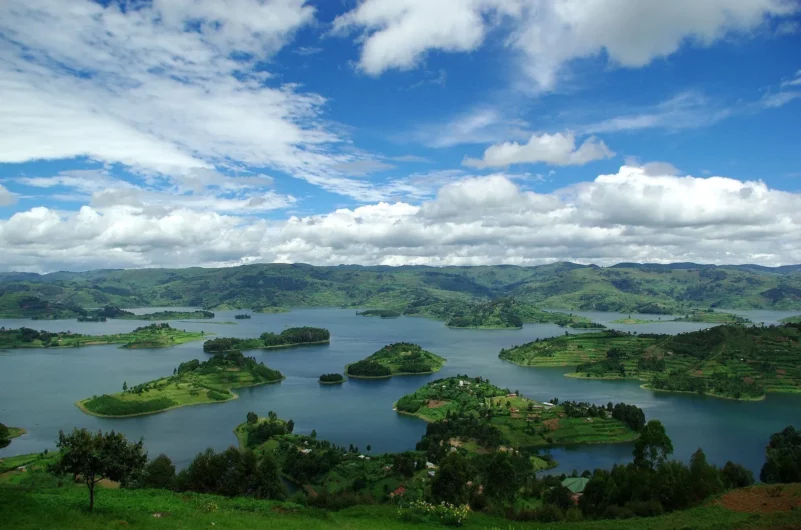
Lake Bunyonyi loosely translated as ‘Lake of many little birds’ is located in south-western and is among Uganda’s top 10 treasured tourist sites. At 44- 900m, the lake is one of the deepest and most beautiful lake in Africa. It is dotted with numerous islands surrounded by terraced landscapes. It supports a rich typical lake culture of fishing, sports including swimming, diving and canoeing. Lake Bunyonyi lies at an altitude of 1840m with surrounding hills up to 2,500 m. Essentially, a flooded valley system, extending northwards from Rwanda border over a distance of 25 kms through the contours of the steep hills that separate Kabale from Kisoro.
The lake’s formation dates to 8000 million years ago, as a result of lava flow from one of the Virunga mountains which blocked off the Ndego river at present day Muko overflow ‘Heisesero’ to create a dam. The lake papyrus and reeds (180km2) forms unique wet land ecosystem, along incorporating the Ruvuma swamp and several other permanent marshes.
ISLANDS
Lake Bunyonyi boasts of 29 islands including;
Punishment Island (Akampene)
Girls who became pregnant before marriage would be canoed to Akampene island where they would either starve to death or die while trying to swim ashore.
Sharp’s Island l (Njuyeera) now Bwama
In the 1920s a missionary named Dr. Leonard Sharp set up a leprosy hospital along with an Anglican Church. It was a place where people with leprosy were isolated from their local communities. Today, it is a school that serves children in the surrounding communities.
Njuyeera
A small island where Dr. Sharp built a white cottage (Njuyeera) that had a tennis court, boat house, guest cottage, windmill and gardens with lemon and guava trees, canna and flame lilies.
HAMUGANDA BLACK SMITHS IRON SMELTING
Large deposits of iron ore exist in southwestern (Kisoro-Kabale) consisting of an iron-rich hematite high grade with few deleterious impurities. Althoughtodate the deposits lay unexploited atlarge scale there are small holder blacksmith activities evident in surrounding villages specifically Bukora home of Bahesi clan–Iron smelters specializing in making knives, spears, pangas sickles and hoes.
FISH CRABS
Lake Bunyonyi’s depth and stratification makes it difficult for the breeding of the common fish species in Uganda such as Nile Perch and Tilapia. Instead it has mud fish, and crab fish a delicacy for tourists.
BIRDS
There are over 200 bird species around Lake Bunyony and these include;- White tailed Blue Monard, African Harrier Hawk, Grey crowned cranes, Herons, Egrets, the Cardinal
woodpecker, the Levillant cuckoo, Sender-billed baglafetch, Weavers and many more.
DUGOUT CANOE SAFARI
While paddling or being paddled on Lake Bunyonyi you do not have to worry about hippos and crocodiles as they do not exist on this pristine and scenic lake. Everything travels
by dugout canoes to the islands, including people and produce.
CAVES
Take nature walks both on the Islands and around the lake to view scenic sites including caves. Walking to the caves is not strenuous and can be taken at slow pace.
CHURCHES
The lake is surrounded by many worship centres including many Anglican Church of Uganda churches, Roman Catholic, Pentecostal and few mosques .
Schools and Health centers
Alongside places of worships, there are several primary schools, very few secondary schools and a handful of technical institutes as well as few health centres.
MARKET DAY
A local market takes place every Friday and Monday at Harutindo landing site offering great opportunities for purchasing fresh foods, handmade
goods and other merchandise popular in the area.
FOG
The lake Bunyonyi fog is a beautiful feature made up from condensed water drops which are the result of the air being cooled to the point where ere it can no longer hold all of the water vapor.
RESEARCH
Adjacent to the late is the Kachwekano Zonal Agricultural Research and Development Institute one of the 14 institutes of the National Agricultural Research and Organisation (NARO) focusing on research and development programmes aimed at increasing agricultural production in the southwestern highland agro-ecological zone specifically irish potatoes, wheat and temperate fruits such as apples and pears.
ROUTES
The shortest distance to the lake is through Kabale Town which is seven kilometres along a graded murram road through Kiyoora past Kacwekano. Two other routes include using the tarmac road to Kisoro hitting the lake at Heisesero or using the tarmac road to Katuna Border town turning south on the murram road though Rubaya/ Rukole then Kitoma. The lake is surrounded by a net work of paths and motorable road all round either on the top of ridges or along the shores.