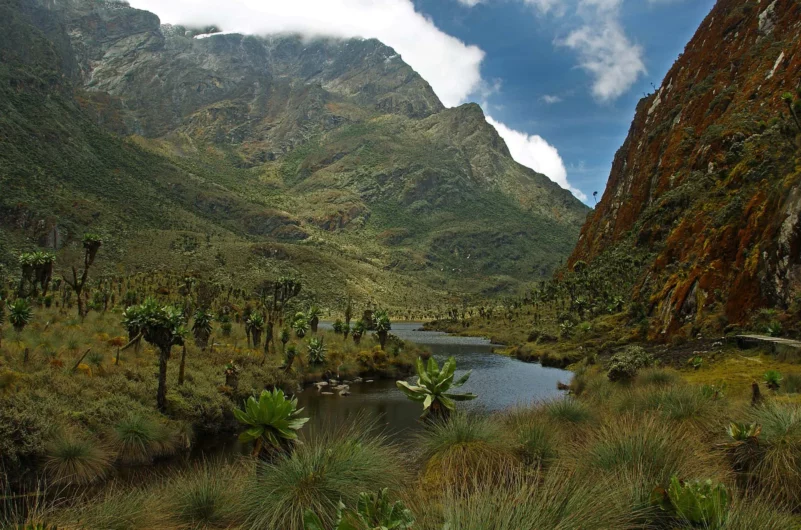
The Ruwenzori, also spelled Rwenzori and Rwenjura, or Rwenzururu are a range of mountains in eastern equatorial Africa, located on the border between Uganda and the Democratic Republic of the Congo. The highest peak of the Ruwenzori reaches 5,109 metres (16,762 ft), and the range’s upper regions are permanently snow-capped and glaciated. Rivers fed by mountain streams form one of the sources of the Nile.[1] Because of this, European explorers linked the Ruwenzori with the legendary Mountains of the Moon, claimed by the Greek scholar Ptolemy as the source of the Nile. Virunga National Park in eastern DR Congo and Rwenzori Mountains National Park in southwestern Uganda are located within the range.
The mountains are occasionally identified with the legendary “Mountains of the Moon“, described in antiquity as the source of the Nile River.[1] Modern European explorers observed the range beginning in the late nineteenth century, with Samuel Baker reporting what he called the “Blue Mountains” looming in the distance in 1864, and Henry M. Stanley visiting the range in 1875 and 1888, when he recorded the name as “Ruwenzori”.[6]
In 1906, the Duke of Abruzzi mounted an expedition to the Ruwenzori, the account of which was subsequently published by Filippo De Filippi. The expedition scaled the highest peaks of the range, several of which were named by the duke, while Mount Luigi di Savoia was named in his honour.[6] Accompanying the duke was photographer Vittorio Sella, who had previously visited the mountains. His photographs of the glaciers and moraines of the Ruwenzori demonstrated that the glaciers were already in retreat.[6][7] Sella’s photographic work is conserved at the Museo Nazionale della Montagna in Turin and at the Istituto di Fotografia Alpina Vittorio Sella in Biella, both in Italy. The Makerere University, Uganda, also has a selection of his images.[8]
The first traverse of the six massifs of the Ruwenzori was done in 1975, starting on 27 January and ending on 13 February. The traverse was done by Polish climbers Janusz Chalecki, Stanisław Cholewa and Leszek Czarnecki, with Mirosław Kuraś accompanying them on the last half of the traverse.[9]